- Agency Benefits
- Strategy
- Social Media
- SEO
- Product Reviews
- Seasonal Promotions
- Property
- Research
- Content
- AI
- Gaming
Dental Marketing UK With SEO Tips For Dentists
By Johan, copywriter at Business Mate. Last updated 20 November 2026.
Dental marketing is how a practice gets found by local patients, earns their trust and turns searches into booked appointments. For most UK practices that means three things done well: local SEO for dentists (your Google Business Profile, reviews and treatment pages), a website that makes booking easy, and a small amount of targeted advertising for high-value treatments. This guide covers each one, the advertising rules dentists must follow and a simple 90-day plan.
Most new patients start with a search such as “dentist near me” or “teeth whitening [town]”. Practices that appear in the map results with strong reviews win most of those patients, whatever their size.
👉 Want more new patients? Book a free call or message us.
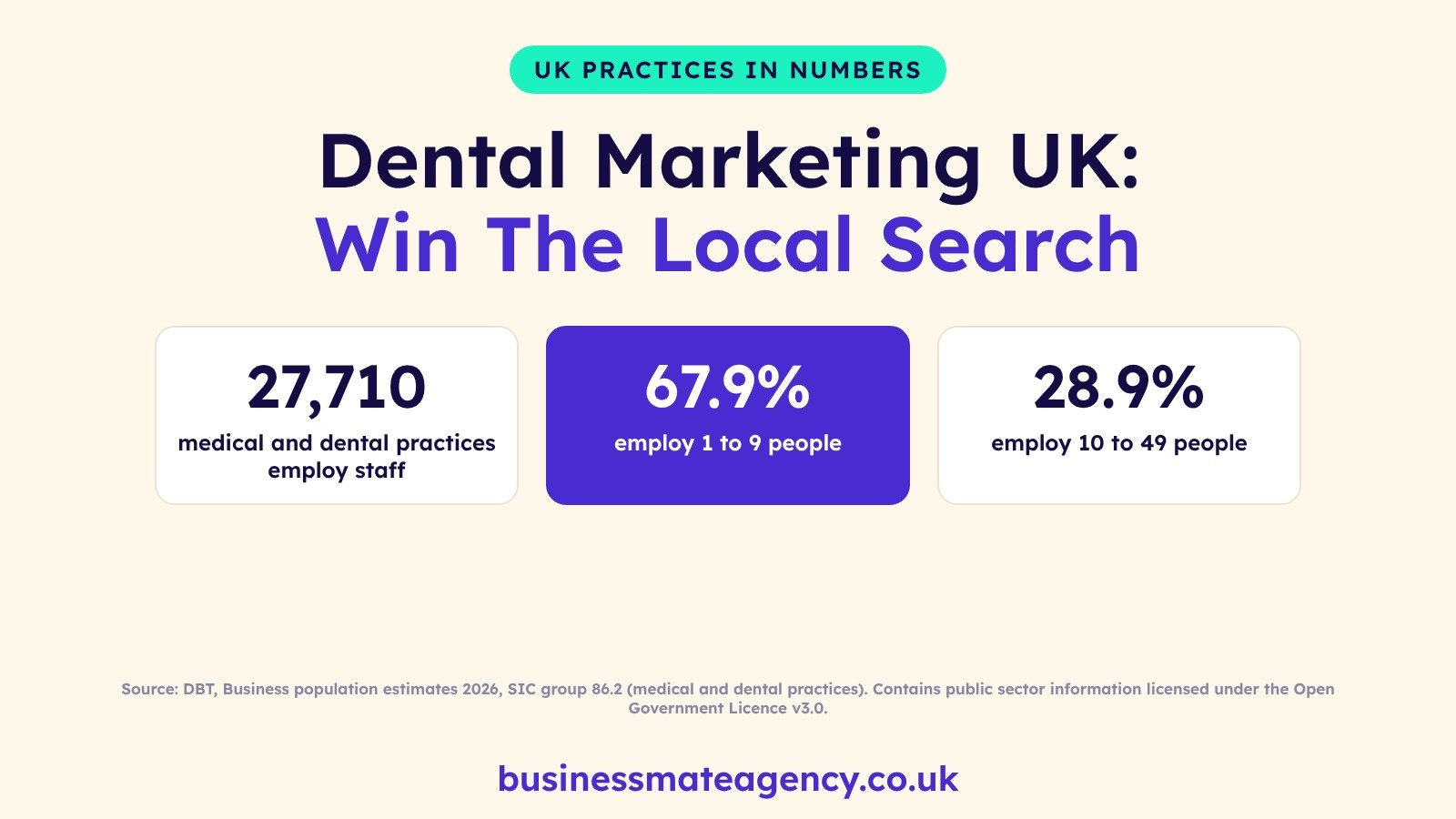
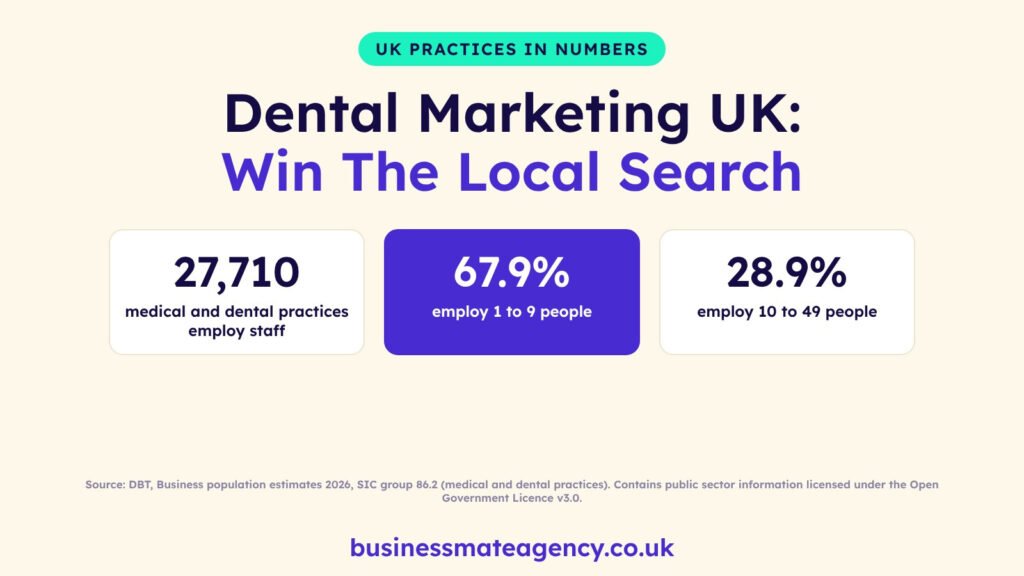
UK Dental And Medical Practices In Numbers
Most practices are small businesses competing in a local area, which is why local search matters so much.
| Figure (UK, start of 2026) | What it means for your marketing |
|---|---|
| 27,710 medical and dental practices employ staff | Patients have a choice, so being visible locally decides who gets the booking |
| 67.9% employ 1 to 9 people | Most competitors have no marketing team either |
| 28.9% employ 10 to 49 people | Larger practices and groups invest more in ads, so small practices win on reviews and local relevance |
Source: Department for Business, Innovation, Science and Trade, Business population estimates for the UK and regions 2026, SIC group 86.2 (medical and dental practice activities, employers only). The group includes GP and specialist medical practices as well as dental practices. Contains public sector information licensed under the Open Government Licence v3.0.
Local SEO For Dentists: Win The Map Results
Local SEO for dentists means appearing in Google’s map results when nearby patients search. Google says local results are based mainly on relevance, distance and prominence, so a complete profile, real reviews and clear treatment pages all help.
- Google Business Profile: choose “Dentist” (or the most accurate category, such as “Cosmetic dentist”) as the primary category, add each treatment as a service, set accurate opening hours and upload real photos of the practice and team. Follow our guide to setting up a Google Business Profile.
- Reviews: ask every happy patient, by text or email after the appointment, and reply to every review politely without sharing any patient details.
- Consistent details: the same practice name, address and phone number on your website, directories and NHS listing.
- Treatment pages: one page each for check-ups, hygiene, whitening, implants, Invisalign or other aligners, emergency appointments and children’s dentistry, each answering the questions patients ask.
Read our local SEO guide for small businesses for the full checklist.
Get found on Google: the free 2027 Marketing Playbook
The plans, checklists and templates we use for UK small businesses. 10 pages, yours free.
By signing up you will get our monthly marketing tips. Unsubscribe any time. Privacy policy.
SEO For Dentists: A Website That Books Appointments
SEO for dentists works best when every page answers a real patient question and ends with an easy way to book. Patients compare practices on a phone, often in a hurry, so speed and clarity matter.
| Element | Why it matters |
|---|---|
| “Book online” and tap-to-call on every page | One clear next step for anxious or busy patients |
| Treatment prices or “from” prices | Private patients compare costs before they call |
| NHS and private information made clear | Answers the first question many patients have |
| Team pages with qualifications you hold | Builds trust before the first visit |
| Fast loading on mobile | Slow pages lose bookings and rankings |
If your site is not appearing at all, start with why your website is not showing on Google and our free SEO audit checklist.
👉 Want a fix list for your practice? Our £180 Local SEO Audit shows what to change first.
The Advertising Rules Dentists Must Follow
Dental marketing is regulated more closely than most. Before you publish adverts, treatment claims, prices or before-and-after photos, check the advertising guidance from the General Dental Council and the UK advertising codes from the Advertising Standards Authority. In general, claims must be accurate and provable, prices must be clear, and patient testimonials and photos need consent. This is a summary, not legal advice.
Paid Ads For High-Value Treatments
Paid ads work best for treatments patients research and pay privately for, such as implants, aligners and whitening. Check-ups and NHS appointments usually come from local search and word of mouth instead.
- Google Search ads: target treatment searches in your area, with a set daily budget. Our Google Ads guide explains the set-up.
- Facebook and Instagram ads: useful for treatments people consider over weeks, with a clear consultation offer.
- Measure cost per booked consultation, not clicks.
Our ad management plans start from £350 a month, with ad spend paid separately to the platforms.
A 90-Day Dental Marketing Plan
| When | Focus |
|---|---|
| Month 1 | Google Business Profile complete, review requests after every appointment, consistent details everywhere |
| Month 2 | One page per treatment with prices or “from” prices and online booking |
| Month 3 | Monthly email to patients who agreed to hear from you; small ads test for one high-value treatment |
Our small business SEO services start from £300 a month for local SEO, and our SEO content writing covers treatment pages from £150 each. For the full picture, see how much SEO costs in the UK.
👉 Ready to fill more appointments? Contact Business Mate or book a free call.
Sources
Every figure and rule in this guide comes from these sources:
- Department for Business, Innovation, Science and Trade, Business population estimates for the UK and regions 2026 (SIC group 86.2, employers only). Contains public sector information licensed under the Open Government Licence v3.0.
- Google Business Profile Help, Tips to improve your local ranking on Google
- Advertising Standards Authority, UK advertising codes
- General Dental Council, standards and guidance for dental professionals
- Business Mate prices: SEO plans, advertising services and shop (checked 20 November 2026)
FAQs
What is the best dental marketing for a small practice?
For most practices, the best results come from local search: a complete Google Business Profile, a steady flow of recent reviews and a website with a page per treatment and online booking. Paid ads work well later for high-value treatments such as implants and aligners.
How does SEO for dentists differ from other SEO?
Dental searches are mostly local and urgent, so the map results matter more than national rankings. Treatment pages, reviews, accurate opening hours and clear NHS or private information do most of the work. Health claims also need extra care to stay accurate and within the advertising rules.
Can dentists use patient reviews and before-and-after photos?
Yes, with care. You need the patient’s consent, the content must be genuine and representative, and claims must be accurate. Check the General Dental Council’s guidance and the UK advertising codes before publishing.
How much does dental marketing cost?
It depends on how much you do yourself. At Business Mate, local SEO plans start from £300 a month, ad management from £350 a month with ad spend separate, and a one-off Local SEO Audit costs £180.
How long does local SEO for dentists take to work?
Profile and review improvements can show within weeks, while new treatment pages usually take three to six months to rank, depending on local competition. Track calls, direction requests and bookings each month.
Can Business Mate market our dental practice?
Yes. We help UK practices with Google Business Profiles, local SEO, treatment pages and ads. Book a free call and we will tell you what to fix first.