- Agency Benefits
- Strategy
- Social Media
- SEO
- Product Reviews
- Seasonal Promotions
- Property
- Research
- Content
- AI
- Gaming
Marketing Mix Modelling Explained For Small Businesses
By Johan, copywriter at Business Mate. Last updated 20 November 2026.
Marketing mix modelling (MMM) is a statistical way to work out how much each marketing channel adds to your sales, using your past sales and spending data rather than tracking individual people. It separates the sales you would have made anyway (your baseline) from the extra sales driven by things like Google Ads, social media, email or leaflets, and allows for seasons and price changes. Big brands have used it for decades; free tools now make a simple version possible for growing small businesses too.
This guide explains how marketing mix modelling works, what data you need, when it is worth it and a small business version you can try in a spreadsheet.
👉 Want to know which marketing actually pays? Book a free call or message us.
What Is Marketing Mix Modelling?
Marketing mix modelling is a statistical model that links your weekly sales to your weekly marketing activity and other factors, then estimates how much each one contributed. It answers questions such as “How many extra sales did our Google Ads bring?” and “What happens if we move £500 a month from Facebook to email?”
It is not the same as the marketing mix (the 4Ps of product, price, place and promotion). MMM measures the “promotion” part with data. Our guide to the marketing mix and the 4Ps and 7Ps covers the theory.
How Marketing Mix Modelling Works
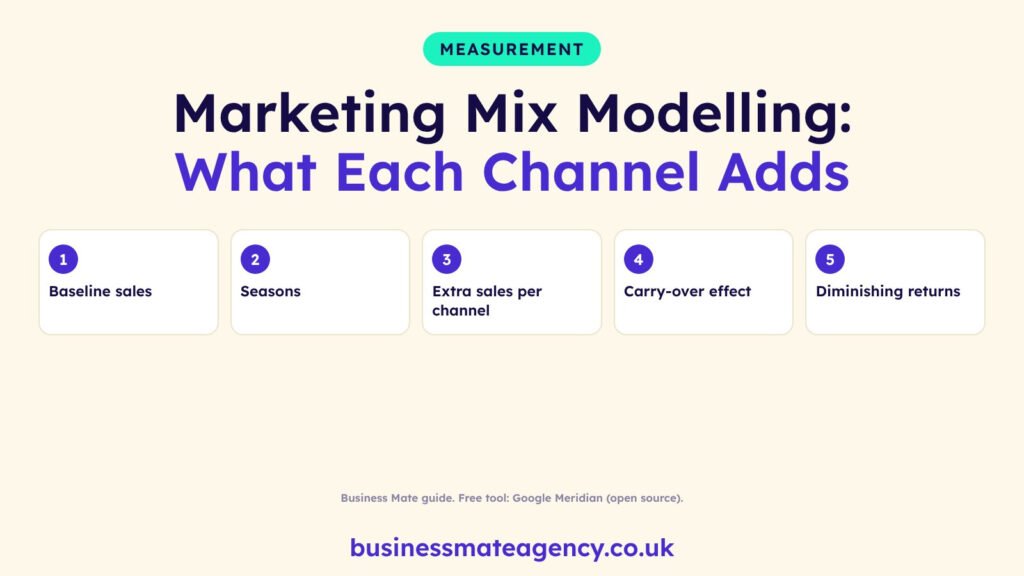
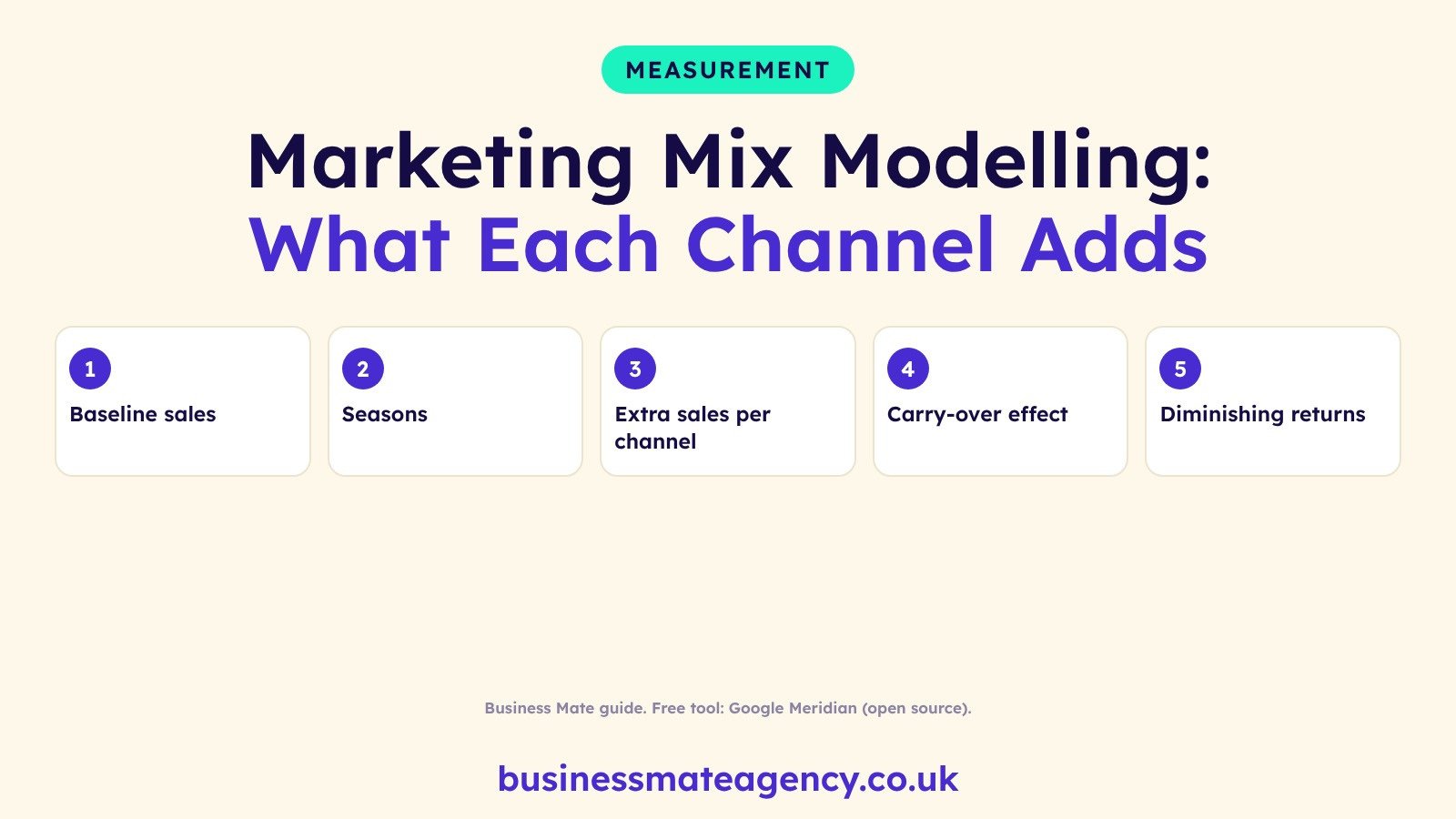
A model splits your sales into parts:
| Part | What it means | Example |
|---|---|---|
| Baseline | Sales you would make with no marketing | Regular customers, word of mouth, walk-ins |
| Seasonality | Predictable ups and downs | Christmas peaks, quiet Januarys |
| Channel effects | Extra sales from each channel | Google Ads, Meta ads, email, leaflets |
| Carry-over | Advertising keeps working for a few weeks | A radio campaign still helping sales a month later |
| Diminishing returns | Each extra pound brings a bit less | Doubling ad spend rarely doubles sales |
Because it uses totals rather than tracking people, MMM still works when cookies are blocked and covers offline channels, which click-based attribution in tools like Google Ads cannot fully see. Google explains the click-based approach in its guide to attribution models.
Get the free 2027 Marketing Playbook
The plans, checklists and templates we use for UK small businesses. 10 pages, yours free.
By signing up you will get our monthly marketing tips. Unsubscribe any time. Privacy policy.
What Data Do You Need?
- Sales or enquiries by week, ideally for two years or more, so the model can see seasons repeat.
- Spend by channel by week, from your ad accounts and invoices.
- Other factors: price changes, promotions, bank holidays, stock problems, opening hours.
- Enough variation: if you spend the same every week, the model cannot tell what works. Planned tests (pausing a channel in one area or month) help a lot.
Getting the data in order is useful on its own. Our one-page marketing plan template and the free playbook above help you start recording it.
Is Marketing Mix Modelling Worth It For A Small Business?
| Probably worth it if… | Not yet if… |
|---|---|
| You spend in three or more channels every month | You use one or two channels |
| You have two years of weekly sales data | You started trading recently |
| You use offline channels (radio, print, leaflets) | Everything is online and trackable |
| Your monthly marketing spend is in the thousands | Your spend is a few hundred pounds a month |
For smaller budgets, simpler measurement gives most of the value: tracked links, asking every new customer “How did you find us?”, and comparing months with and without a channel.
👉 Want a measurement plan that fits your size? Our £120 strategy call and action plan covers it.
A Simple Small Business Version (Worked Example)
This illustrative example uses made-up round numbers to show the method. A local gym tracks new members and marketing spend each month for a year.
| Month type | Meta ads spend | Leaflets | Average new members |
|---|---|---|---|
| No ads, no leaflets | £0 | No | 20 |
| Ads only | £500 | No | 30 |
| Leaflets only | £0 | Yes (£300) | 24 |
| Both | £500 | Yes (£300) | 33 |
Reading the table: the baseline is about 20 members a month. Ads add about 10 members for £500, or £50 per member. Leaflets add about 4 for £300, or £75 per member. Together they add 13, not 14, a sign of diminishing returns. A real model does this with more data and adjusts for seasons, but the logic is the same. If January is always busy for a gym, compare like with like or the season will look like an advertising effect.
Free Marketing Mix Modelling Tools
- Google Meridian: Google’s open-source MMM, free to use, which you can run on your own data.
- Robyn: Meta’s open-source MMM package.
- A spreadsheet: for a first look, a monthly table like the one above plus planned tests.
The free tools need some data skills to set up. Many small businesses get more value from clean tracking first; our free marketing tools guide covers Google Analytics and Search Console.
How To Act On The Results
- Move budget towards channels with the lowest cost per extra sale.
- Check for diminishing returns before increasing any one channel a lot.
- Keep testing: pause or increase a channel for a set period and measure again.
- Review every quarter alongside your marketing strategy.
For paid channels, see our Google Ads guide and Meta ads guide. Our marketing packages include monthly reporting on enquiries by channel.
👉 Ready to put your budget where it works? Contact Business Mate or book a free call.
Sources
The methods and tools in this guide come from these sources:
- Google for Developers, Meridian (open-source marketing mix model)
- Google Ads Help, About attribution models
- Worked example: illustrative figures by Business Mate, not client data
- Business Mate prices: shop and packages (checked 20 November 2026)
FAQs
What is marketing mix modelling in simple terms?
It is a statistical method that uses your past weekly sales and marketing spend to estimate how many extra sales each channel produced. It separates your baseline sales from the effect of each channel, seasons and promotions.
How is marketing mix modelling different from attribution?
Attribution follows individual clicks and gives credit to the ads people clicked. Marketing mix modelling uses totals over time, so it covers offline channels and still works when tracking is blocked, but it needs more historical data.
How much data do I need for marketing mix modelling?
Ideally two years or more of weekly sales and spend by channel, plus notes on promotions, price changes and holidays. With less data, simple tests and tracked links give more reliable answers.
Is there a free marketing mix modelling tool?
Yes. Google Meridian and Meta’s Robyn are free, open-source tools. Both need some data and coding skills to set up and run.
Is marketing mix modelling worth it for a small business?
It is worth it when you spend in several channels, including offline ones, and have enough history. With one or two online channels and a small budget, tracked links and asking customers how they found you are usually enough.
Can Business Mate help measure our marketing?
Yes. We set up tracking, report on enquiries by channel and help you move budget to what works. Book a free call to talk about your numbers.