UK Small Business Trends 2026: 5 Things The New Data Shows
The government’s latest business figures are out, and we have turned them into the first edition of our UK Small Business Marketing Index. Here are the 5 trends that matter most for marketing in 2026, plus our view on what comes next.
All figures come from Business population estimates for the UK and regions 2026, published on 5 November 2026 by the Department for Business, Innovation, Science and Trade. Growth percentages are calculated by Business Mate. Contains public sector information licensed under the Open Government Licence v3.0.
1. Almost Every UK Business Is Small
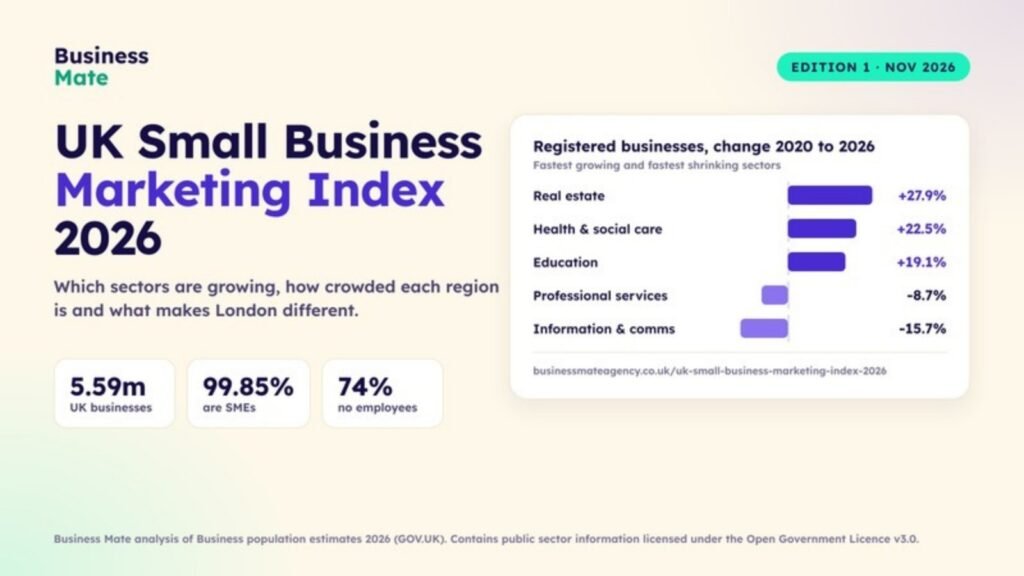
There were 5.59 million private sector businesses in the UK at the start of 2026, and 99.85% of them were SMEs with fewer than 250 employees. Together, SMEs account for 60% of private sector jobs (17 million) and around half of private sector turnover (£2.78 trillion).
2. Three In Four Businesses Are A Team Of One
4.1 million businesses (74%) have no employees apart from the owner. Only 1.5 million (26%) employ anyone. For most UK businesses, the owner is also the marketing department, so marketing has to be simple enough to keep doing every week.
3. Real Estate, Health And Education Are Growing Fastest
Looking at registered businesses (those registered for VAT and/or PAYE), the sectors that grew most between the start of 2020 and the start of 2026 were:
- Real estate: +27.9% (99,100 to 126,700)
- Health and social care: +22.5% (83,000 to 101,700)
- Education: +19.1% (35,000 to 41,700)
- Other services, such as hair, beauty and repairs: +15.5% (89,300 to 103,100)
The biggest falls were in information and communication (-15.7%) and professional, scientific and technical services (-8.7%). More businesses in a sector means more competition for the same customers.
4. London Is The Most Crowded Market In The UK
London has 1,362 private sector businesses per 10,000 adults, the highest of any UK region and almost twice the North East (714). The South East (1,100) and South West (1,082) follow. In crowded areas, local search results and reviews decide who gets found first.
5. London’s Competition Is Concentrated In Digital And Finance
Our analysis shows information and communication businesses are 1.75 times more common in London than across the UK, and finance and insurance businesses 1.5 times. Construction (0.77 times) and manufacturing (0.61 times) are less common in London than nationally.
See all the charts and the full data table in the UK Small Business Marketing Index 2026.
What This Means For Your Marketing
- In a growing sector: expect more competitors each year. A complete Google Business Profile, regular reviews and clear service pages help you stand out.
- In a busy region: local SEO matters. Make sure your location, opening hours and services are consistent everywhere online.
- If you run the business alone: pick two channels and a weekly routine you can keep. Consistency matters more than volume.
Our View: What We Expect Next
This section is Business Mate’s opinion based on the trends above. It is not a forecast of results, and it is not business or financial advice.
- Local search will get more competitive in the fastest growing sectors. With more registered real estate, health and beauty businesses, we expect more of them competing for the same map and local results.
- Simple, repeatable marketing will matter more. With most businesses run by one person, we expect owners to favour marketing they can keep up every week over occasional big campaigns.
- Specialists will stand out in London. In sectors that are already crowded in London, we expect clear positioning and proof, such as reviews and case studies, to matter more than broad claims.
We will check these views against the 2027 figures when they are published, in a new 2027 edition of the Index.
Use Our Data
You are welcome to quote the Index and its charts with credit and a link. Suggested citation: Business Mate (2026), UK Small Business Marketing Index, Edition 1, using Business population estimates 2026. View the Index.
Want Marketing Built On Real Data?
Book a free call and we will show you what these numbers mean for your market, or contact us.
FAQs
How many businesses are there in the UK in 2026?
There were 5.59 million private sector businesses in the UK at the start of 2026, according to the government’s Business population estimates 2026.
Which UK sectors are growing fastest?
Among registered businesses, real estate (+27.9%), health and social care (+22.5%) and education (+19.1%) grew most between the start of 2020 and the start of 2026, based on Business Mate’s analysis of the government’s figures.
Which UK region has the most businesses per person?
London, with 1,362 private sector businesses per 10,000 adults at the start of 2026. The North East has the fewest among English regions, with 714.