- Agency Benefits
- Strategy
- Social Media
- SEO
- Product Reviews
- Seasonal Promotions
- Property
- Content
- AI
- Gaming
- Research
Boxing Day Sales UK: When They Start, And What 38 Years Of Official Data Show
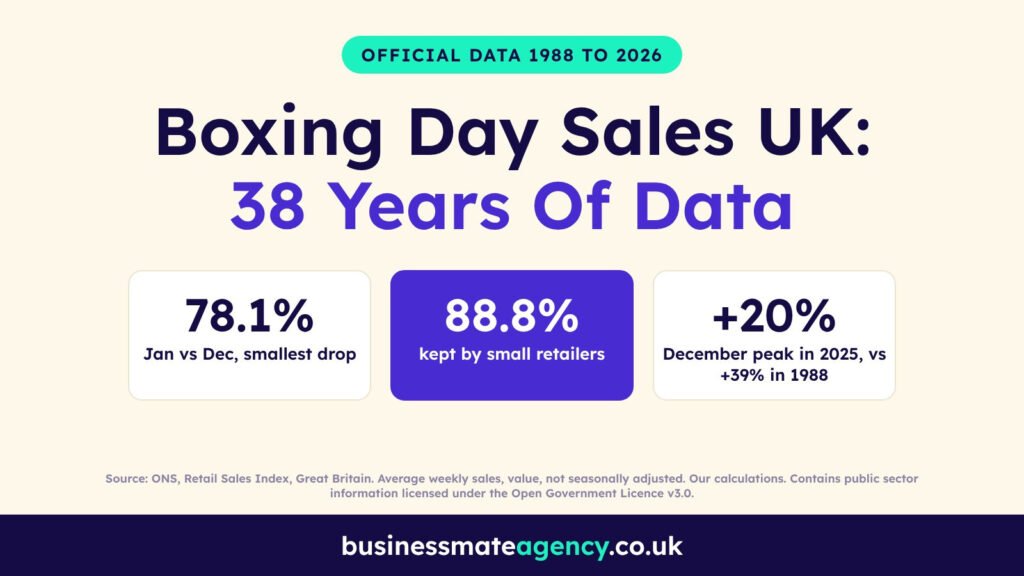
Key findings: Boxing Day sales start the biggest discount season of the year, but what happens to spending afterwards? After Christmas, weekly retail sales in Great Britain always fall. But the drop is getting smaller. Last winter, weekly sales in the January 2026 period were 78.1% of the December 2025 level, the smallest post-Christmas drop in 38 winters of official records going back to 1988. Small retailers held on to 88.8% of their December weekly sales, compared with 75.3% for large retailers. Household goods stores sold as much a week in January as in December.
Source: Office for National Statistics (ONS), Retail Sales Index, Great Britain, time series dataset (DRSI), release of 23 October 2026. Value index numbers of average weekly sales, not seasonally adjusted: all retailing excluding fuel (J43S), large businesses (J43T), small businesses (J43U), volume (J448), food stores (EAFS), non-food stores (EAFT), clothing and footwear (EAFU), household goods (EAFV), other non-food (EAFW), non-specialised non-food stores (EAGE) and internet sales (KP5W). Reporting periods: ONS, Retail sales reporting periods 1986 to 2025. Covers Great Britain (England, Scotland and Wales). Contains public sector information licensed under the Open Government Licence v3.0. Percentages and comparisons are our calculations from the published index numbers. Christmas trading rules: Christmas Day (Trading) Act 2004 and Christmas Day and New Year’s Day Trading (Scotland) Act 2007, legislation.gov.uk. Analysis by Business Mate.
When Do Boxing Day Sales Start And End?
There is no official start or end date. Retailers set their own. In England and Wales, large shops (over 280 square metres) must close on Christmas Day under the Christmas Day (Trading) Act 2004, and in Scotland large shops must close on Christmas Day under the Christmas Day and New Year’s Day Trading (Scotland) Act 2007. So Boxing Day, 26 December, is the first day many big stores can open for their sales, although many retailers start their sales online earlier. Sales then usually run into January, which is why Boxing Day sales and January sales are often treated as one season.
Where Are Boxing Day Sales In The Official Figures?
The ONS does not publish a separate figure for Boxing Day. Its retail “months” are reporting periods of four or five weeks, and the December period runs to the end of December or the first days of January. December 2024 covered 24 November to 28 December 2024, and December 2025 covered 30 November 2025 to 3 January 2026. So Boxing Day sales are counted in December, and the January figure shows the rest of the January sales.
Because periods have different lengths, we compare average weekly sales, which is how the ONS index is measured. That makes a four-week January and a five-week December fair to compare.
How Much Do Sales Drop After Boxing Day?
In a typical winter, January’s weekly sales are around 70% to 75% of December’s. Last winter broke the pattern.
| Winter | January weekly sales as a share of December |
|---|---|
| 2016/17 | 69.5% |
| 2017/18 | 69.4% |
| 2018/19 | 70.5% |
| 2019/20 | 70.8% |
| 2020/21 | 69.3% |
| 2021/22 | 75.0% |
| 2022/23 | 74.0% |
| 2023/24 | 75.8% |
| 2024/25 | 73.1% |
| 2025/26 | 78.1% (highest since 1988) |
The same is true once price changes are taken out. In volume terms, January 2026 was 78.7% of December 2025, also the highest since records began in 1988.
Are Boxing Day Sales Getting Smaller?
The official figures cannot isolate Boxing Day, but they show the whole Christmas and Boxing Day period is less of a spike than it used to be. December is not as far above the rest of the year as it was. We compared December’s weekly sales with the average week of the same year.
| Years | December weekly sales above the average week (average) | January weekly sales as a share of December (average) |
|---|---|---|
| 1988 to 1997 | +33.7% | 71.3% |
| 1998 to 2007 | +31.3% | 71.3% |
| 2008 to 2017 | +29.8% | 70.5% |
| 2018 to 2025 | +24.6% | 73.3% |
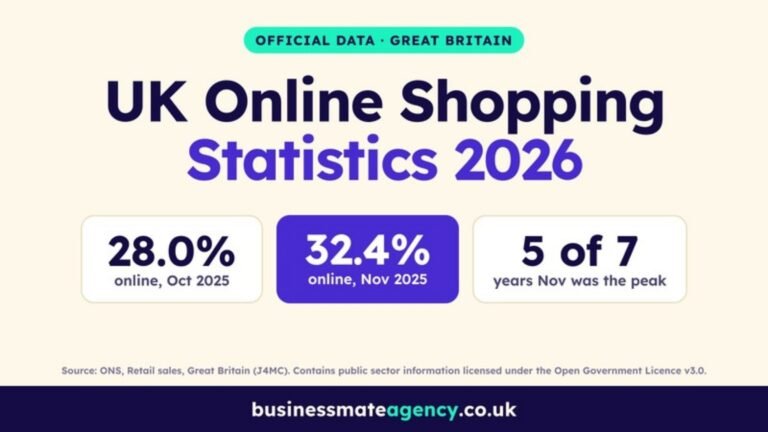
In 1988, December’s weekly sales were 39.4% above the average week. In 2025 they were 20.1% above. The smallest December peak on record was 2023, at 19.9%. Part of the change is timing: November, the month of Black Friday, is now the peak month for online shopping. See our UK Online Shopping Statistics 2026.
Small Retailers Vs Large Retailers
The ONS publishes separate figures for small and large retailers (large retailers are broadly those with 100 or more employees). This is where the data gets interesting for small businesses.
| Winter | Small retailers: January as a share of December | Large retailers: January as a share of December |
|---|---|---|
| 2019/20 | 74.5% | 69.8% |
| 2020/21 | 73.8% | 68.0% |
| 2021/22 | 84.7% | 72.3% |
| 2022/23 | 86.9% | 70.9% |
| 2023/24 | 86.8% | 73.1% |
| 2024/25 | 77.8% | 71.9% |
| 2025/26 | 88.8% | 75.3% |
Small retailers lost far less after Christmas in every one of these winters. The reason is that their Christmas peak is much flatter. In 2025, small retailers’ weekly sales in December were 9.2% above their average week. For large retailers, it was 23.3%. Both January figures for 2025/26 were the highest on record for each group.
Which Shops Fall Most After Christmas?
| Type of shop | January as a share of December, 2025/26 | Average, 2015/16 to 2024/25 | December above the average week, 2025 |
|---|---|---|---|
| Household goods stores | 100.3% | 90.0% | -1.8% |
| Food stores | 86.2% | 81.2% | +12.2% |
| Online (all retailers) | 75.8% | 71.8% | +29.2% |
| Other non-food stores | 68.8% | 60.4% | +29.5% |
| Clothing and footwear stores | 62.1% | 57.1% | +37.8% |
| Department and general stores | 59.0% | 56.0% | +42.9% |
Household goods stores, which include furniture and DIY, sold slightly more a week in January 2026 than in December 2025, the first time on record. The ONS noted that retailers put this down to good January sales for furniture. Their December peak has almost disappeared: it averaged 30.1% above the average week in 1988 to 1997, and 4.8% in 2018 to 2025.
Department stores and clothing shops have the steepest fall. Their December is the most Christmas-driven, so January drops by around 40%. The lowest January on record for clothing was 2020/21 (38.6% of December), when non-essential shops were closed during lockdown.
Online After Christmas
Online sales fall after Christmas too. In 2025/26, January’s online weekly sales were 75.8% of December’s. December’s online peak has also flattened: 62.3% above the average week in 2007, and 29.2% in 2025.
When Will This Winter’s Figures Be Published?
The ONS usually publishes December retail sales in the second half of January, and January’s figures in February. We will update this page with the 2026/27 winter when they are released.
What The Figures Show For Marketing
- January is not dead. Across all retail, the average January week was about three-quarters of a December week in recent winters, and more for small retailers.
- The fall depends on what you sell. Food and household goods hold up well. Clothing, gifts and department stores fall the most.
- Boxing Day sales sit in December. In the official figures, Boxing Day is part of the December period, so the January figure is the true “after Christmas” picture.
This is a research summary of official statistics. It is not business, financial or legal advice. Figures are in current prices and not seasonally adjusted unless stated. Reporting periods vary slightly from year to year.
Use These Statistics
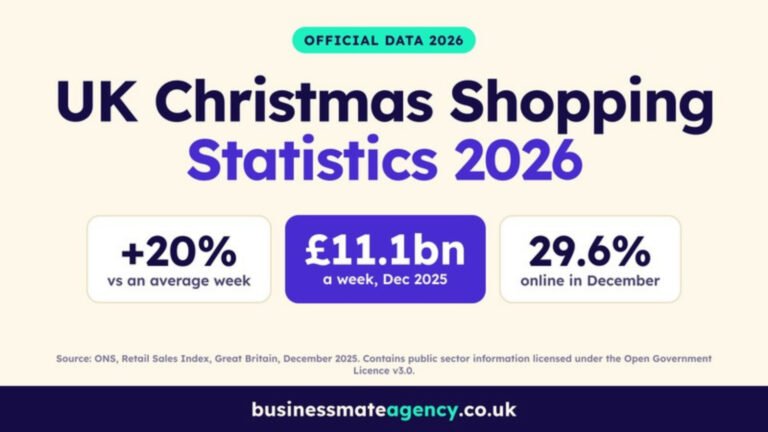
You are welcome to quote these figures with credit and a link. Suggested citation: Business Mate (2026), Boxing Day Sales UK: 38 Years Of Official Data, using the ONS Retail Sales Index. See also our UK Christmas Shopping Statistics 2026.
Want Your Marketing Built On Real Data?
Book a free call or message us and we will take a look at your website and marketing.
FAQs
When do Boxing Day sales start?
Retailers choose their own dates. Large shops in England, Wales and Scotland must close on Christmas Day by law, so many in-store Boxing Day sales start on 26 December, while many retailers launch their sales online earlier. Sales usually continue into January.
Are Boxing Day sales getting smaller?
The Christmas period is less of a spike than it was. ONS figures show December’s weekly retail sales were 39.4% above the average week of the year in 1988, and 20.1% above in 2025. Boxing Day itself is not published separately; it is counted in the ONS December period.
How much do retail sales fall in January?
In the January 2026 period, average weekly retail sales in Great Britain were 78.1% of the December 2025 level, a fall of about 22%. That was the smallest post-Christmas fall since ONS records began in 1988. In the nine winters before, the fall was between 24% and 31%.
Are Boxing Day sales included in December or January figures?
December. The ONS December reporting period runs to the end of December or the first days of January (for example, 30 November 2025 to 3 January 2026), so Boxing Day is counted in December.
Do small shops lose less after Christmas?
Yes. In the January 2026 period, small retailers’ weekly sales were 88.8% of their December level, compared with 75.3% for large retailers, according to ONS figures. Small retailers have a much smaller Christmas peak.